


TL;DR: A sideboard works in a Dubai home when its depth, doors and storage are planned around the room in use, not merely the empty wall.
Key takeaways
- Measure the sideboard with every door and drawer open.
- Protect the main walking route and dining-chair pullback zone.
- Give each shelf and drawer a named storage job before choosing the interior.
- Confirm cable access and ventilation if equipment will sit inside.
- Check packed dimensions against lifts, doors and corridor turns.
How big should a sideboard be?
The right sideboard is wide enough for its storage job but shallow enough to preserve circulation. Start with the usable wall, skirting, sockets, switches and nearby door swings.
Tape the full footprint on the floor. Then add the projection of open doors and drawers. Move the dining chairs into occupied positions and walk the normal route between the kitchen, table and living area.
This rehearsal is more useful than choosing a cabinet because it looks reassuringly slim from the front. Furniture has depth, even when product photography has politely avoided mentioning it.

FCI UAE's live guide to sideboards for Dubai villas gives broader context on storage, scale and dining-room flow.
Where should a sideboard sit?
A sideboard should sit where it supports the room without narrowing its busiest route. In a dining room, that usually means convenient access for serving and storage without crowding seated guests.
In an entrance, check the open front door, visitor route and sightline from adjoining spaces. In an open-plan room, align the cabinet with the zone it serves rather than centring it automatically on the longest wall.
The Dubai open-plan living room guide explains why circulation and zones should be resolved together. A cabinet can anchor a dining area, but it should not become an upholstered obstacle course's wooden finale.
What should go inside it?
Specify the contents before specifying the internal layout. Crockery, serving dishes, linens, glassware, paperwork and media equipment need different shelf heights, drawer depths and hardware.
Make a simple inventory. Record the tallest object, the widest stack and anything heavy or fragile. Adjustable shelves create flexibility, but only within the cabinet's structural and hardware limits.
Ask whether shelves are removable, what load guidance the maker provides and how drawers are divided. Deep shelves can waste space when smaller objects disappear behind one another. More volume is not automatically more useful storage.

Hinged doors, sliding doors or drawers?
Choose the front according to opening space, visibility and daily access. Hinged doors reveal more of the interior but project into the room. Sliding doors save opening space but usually expose one section at a time.
Drawers are useful for linens, cutlery and smaller objects when their internal dimensions suit the contents. Test the handles, closing action and reach. If a dining chair must be moved whenever one drawer opens, the layout is charging a small convenience tax at every meal.
For push-to-open fronts, test the action and ask how alignment is adjusted. For handles, check that projections do not catch clothing in a narrow route.
Can a sideboard hold media equipment?
It can, but cable routes, ventilation and remote-control access must be designed for the actual equipment. Do not assume a decorative cabinet is ready to become a media unit.
List the devices, plug shapes, transformers and cable bend space. Confirm where heat can leave the cabinet and how equipment can be reached for service. Closed doors may affect controls or wireless performance depending on the device and material.
Obtain the equipment maker's ventilation instructions and the cabinet maker's load limits. Cutting a cable hole after delivery is not a refined design detail. It is a delayed specification.
Which material and finish should you choose?
Choose the finish according to touch, cleaning, sunlight and the objects placed on top. Timber, veneer, lacquer, glass, metal, ceramic and stone have different care requirements and visual weight.

View physical samples in the room's daylight and evening lighting. Ask for written guidance on heat, spills, abrasives and cleaning products. If the top will be used for serving, agree how it will be protected.
Inspect the sideboard from the sides as well as the front, especially when it is visible from an entrance or open-plan seating area. A beautiful elevation cannot rescue unresolved side panels and cables.
Will it fit through the building?
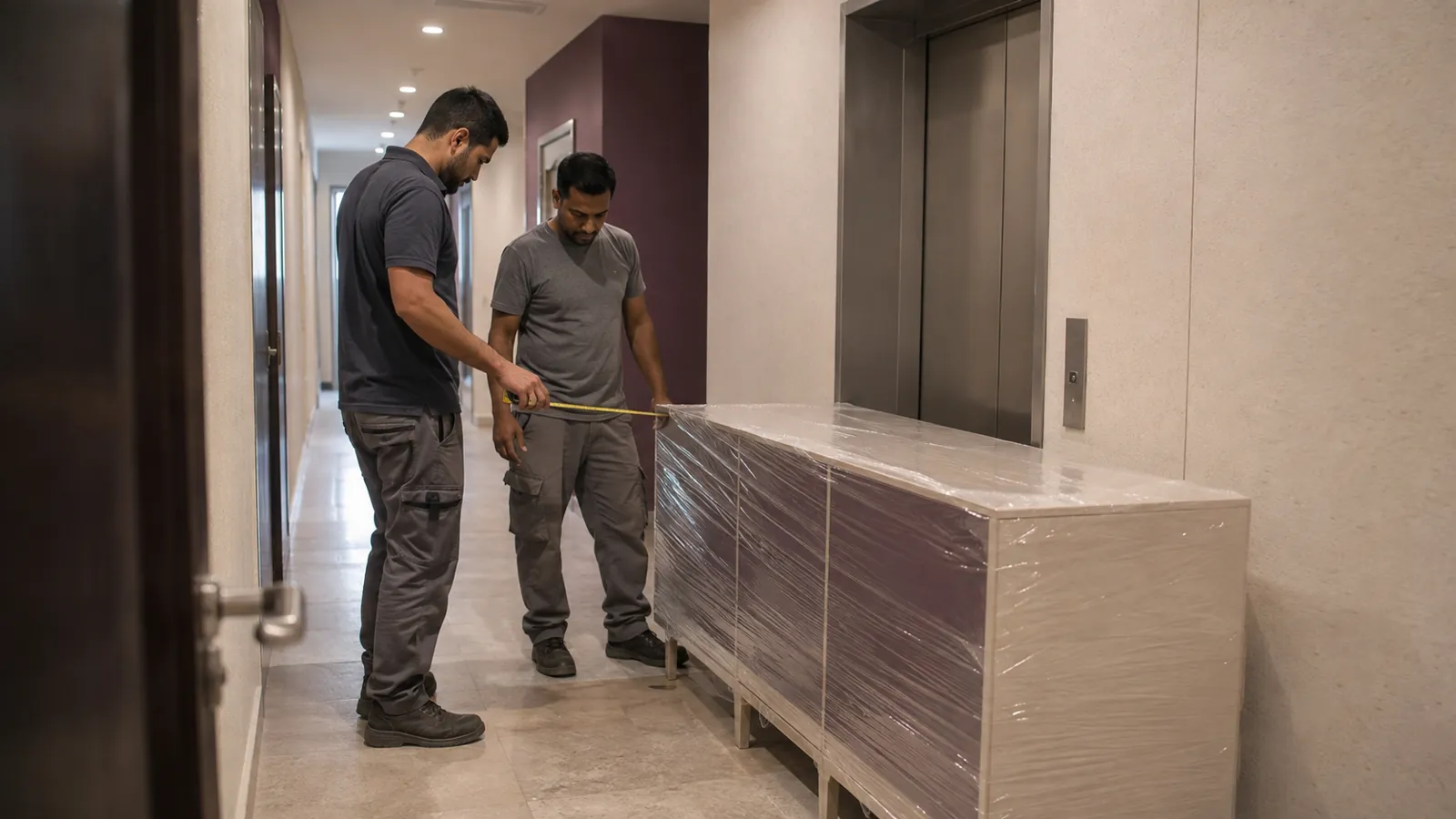
Confirm the packed size and component breakdown against the narrowest point of the complete delivery route. Measure lift doors, cabin depth, corridors, apartment doors, turns and any steps.
FCI UAE's verified furniture delivery access checklist explains how to survey that route. Ask what arrives assembled, what can be separated and who performs final levelling and adjustment.
Photograph restrictions and share them before ordering. Also confirm building delivery procedures with the property manager, because access arrangements can change.
What should you approve before ordering?
Approve a dimensioned drawing, finish sample and internal specification. The drawing should show overall width, height and depth, open-door projection, shelf positions, hardware, cable routes and wall interfaces.
Check sockets, skirting and floor levels on site. For wall-fixed or tall units, follow the maker's installation requirements and use suitable professional installation for the actual wall construction.
If the sideboard forms part of a larger scheme, review FCI UAE's luxury interior procurement service and bring a room plan, storage inventory and delivery survey to the brief.
Limitations
This guide cannot confirm whether a specific sideboard fits or is suitable without the maker's current technical information and a measured site survey. Load limits, wall fixings, ventilation, finishes and installation vary by product and property. Confirm them in writing before purchase.