

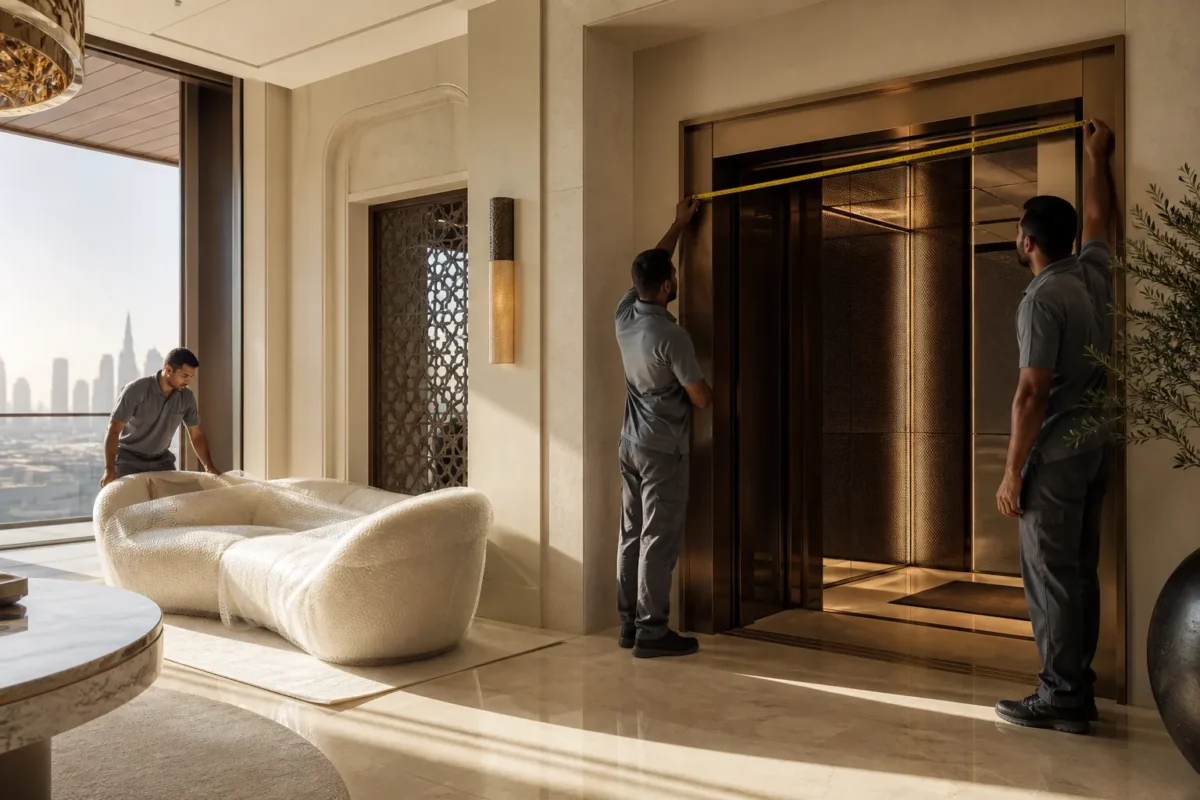
A sofa can fit a Dubai apartment beautifully on a floor plan and still fail at the loading bay, service lift or final turn into the room. The expensive error is treating room dimensions as the whole problem. For apartment furniture, the delivery route is part of the specification.
TL;DR: Before you approve any large piece, record its packed transport dimensions, every route constraint and its assembly strategy in one document, because the delivery route is part of the specification.
Key takeaways
- A sofa can fit on the floor plan yet fail at the loading bay, service lift or final turn, so treat the delivery route as part of the specification.
- Measure five points that are not room dimensions: the loading bay, building entrance, service lift, corridors and turns, and the apartment or room.
- Ask suppliers for packed transport dimensions, not just finished dimensions, plus package count, weights, detachable components and assembly space.
- Confirm the building-management gate first: permits, advance notice, service-lift reservation, delivery windows, deposits and sign-off.
- Give every item a Green, Amber or Red status on a one-page access schedule before you pay a non-refundable balance or release bespoke production.
Why should delivery access be decided before colour and fabric?
Decide delivery access before colour and fabric, because a piece that cannot reach the room is a problem no finish can solve. Do not approve a large item until its packed transport dimensions, every route constraint and its assembly strategy are recorded in the same document. Getting the route right first is what protects the rest of the brief, whether you are furnishing a single apartment or using our luxury furniture procurement service for the whole home.
Which five measurements matter that are not room dimensions?
Five measurement points decide whether a piece arrives intact, and none of them is a room dimension:
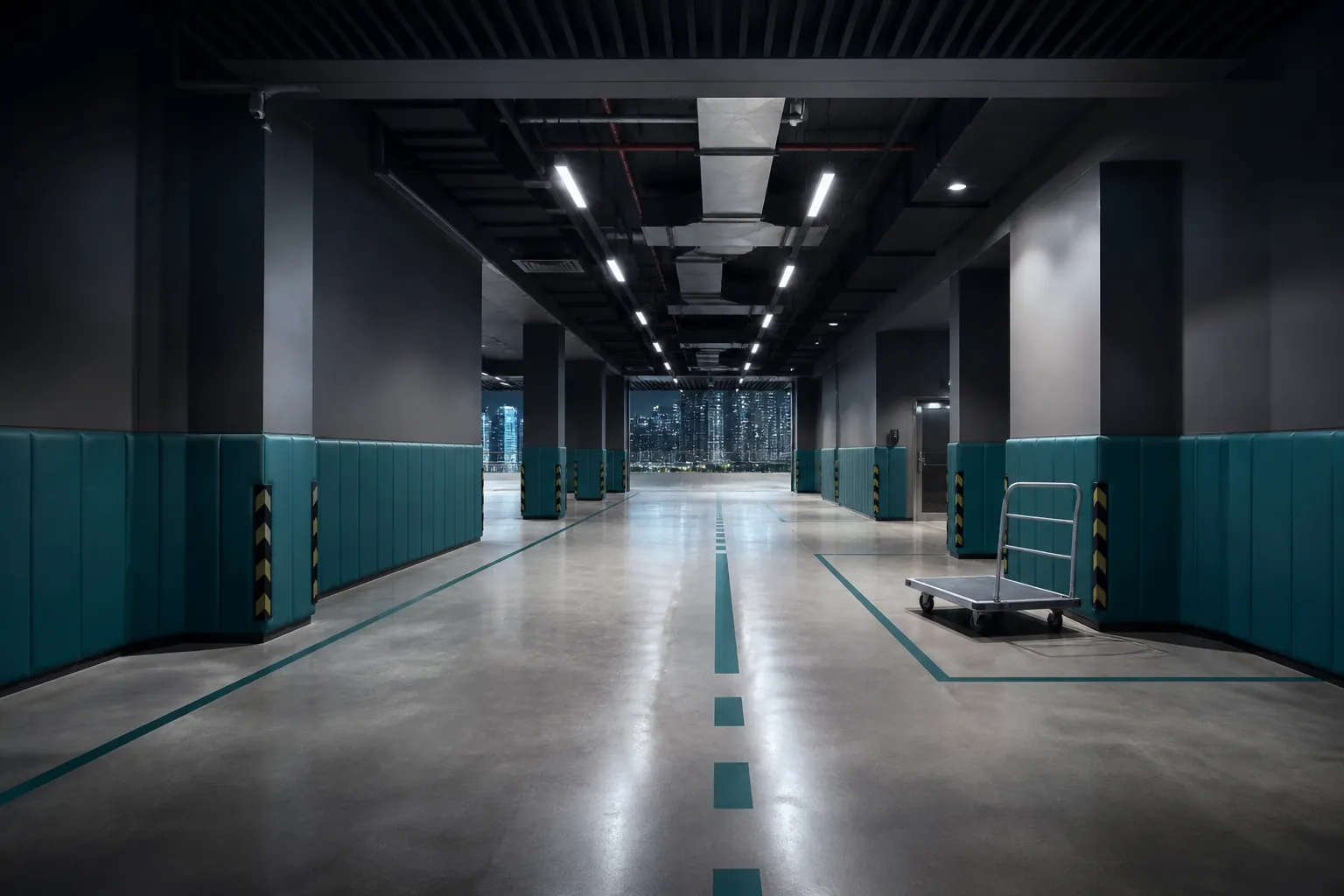
- Loading bay, height, vehicle length, dock edge and trolley route.
- Building entrance, clear door width and height.
- Service lift, clear door, cabin dimensions and load limit.
- Corridors and turns, narrowest width and ceiling height.
- Apartment and room, entrance, internal doors, the final turn and ceiling.
The tightest point on that route, not the room, sets the limit for every large item.
What should you ask suppliers for, transport or finished dimensions?
Ask for transport dimensions, not just finished dimensions, because a piece travels packed, not assembled. Request the following from every supplier before you approve an item:
- Number of packages.
- Each package's dimensions and weight.
- Packaging removal procedures.
- The smallest safe transport orientation.
- Detachable components.
- Lifting points.
- Assembly space requirements.
- Crew and handling specifications.
What do you need to confirm with building management?
Confirm the building-management gate before delivery is booked, as access rules can stop a delivery that the dimensions would otherwise allow. Ask management:
- Is a move-in or furniture-delivery permit required?
- What advance notice is needed?
- Can the service lift be reserved?
- Are there delivery windows or time restrictions?
- Is contractor documentation needed?
- Are damage deposits required?
- Which loading bay or entrance must be used?
- What are the protection inspection procedures?
- Where is packaging removed?
- What is the completion sign-off process?
Which access strategy fits your piece?
Choose one of four access strategies for each item, matched to how it travels and where it is built:
- Direct route, the item passes all constraints with handling margin.
- Modular or knock-down, disassembly for deep sofas, beds and storage.
- Final assembly inside, for pieces designed for assembly.
- Alternative engineered access, balcony or façade access, which requires approval and a specialist.
How do you keep it all on one page?
Build a one-page furniture access schedule so every item's route and status is visible at a glance. Give each piece a status:
- Green, documented route and approved handling.
- Amber, unresolved rules or missing dimensions.
- Red, a known obstruction or overweight component.

The same discipline scales from one apartment to a whole-home procurement checklist.
How do you protect the apartment and the furniture on the day?
Protect the apartment and the furniture by putting the delivery lead in charge of the controls, not the crew improvising on arrival. The delivery lead should manage:
- Clean, non-marking trolleys.
- Corner, door and floor protection.
- A clear holding area.
- Safe packaging removal.
- Hardware accountability.
- Final levelling and assembly.
- Photographic documentation.
What is a two-stage handover?
A two-stage handover checks the delivery twice, so faults are caught before the crew leaves rather than after. Stage one: check quantity, model, finish, transport damage and components before the crew departs. Stage two: verify alignment, stability, operation, seams, edges, functions, floor contact and wall clearances.
What are the limitations to keep in view?
Keep in view that even a documented route depends on accurate supplier information and current building rules, both of which can change between order and delivery. The access schedule reduces risk; it does not remove the need to confirm details close to the delivery date. Pairing it with a considered Dubai furniture packages buyer guide helps keep product and route decisions aligned from the start.
What is the practical next step?
The practical next step is to prepare the access schedule before you pay a non-refundable balance or release bespoke production. Discuss your apartment furniture brief with FCI UAE to coordinate product, route and installation dependencies, or book a design consultation at our Dubai showroom.

Sources
- FCI UAE, luxury interior procurement
- FCI UAE, Dubai furniture packages buyer guide
- Maawa, Dubai move-in and move-out permit overview
- SAMA Movers, move-in permit and service-lift market guidance
- FCI UAE, whole-villa procurement checklist