


Furnishing a Dubai villa well looks effortless from the outside. The reality is that the effort happens long before the delivery truck arrives, in the order you make decisions. Get the sequence right and the rooms settle into place. Get it wrong and no amount of beautiful furniture will save you.
TL;DR: Furnishing a Dubai villa well is a sequencing problem, not a taste problem: define use, verify measurements, control samples and design delivery before you release a single order.
Key Takeaways
- The most common villa failures (a sofa blocking the terrace route, a pendant off-centre, a one-piece headboard that cannot turn on the stair, six suppliers arriving on the same morning) come from poor sequencing, not poor taste.
- Follow a ten-point order: verify the site, freeze room use and circulation, classify every item by dependency, approve dimensions and interfaces, lock access, order long-lead pieces first, inspect before dispatch where warranted, install in sequence, snag, then style.
- Four risks recur: scale, interface, access and concentration. New furniture releases simultaneous emissions from coatings, adhesives, composite wood, cabinetry and fabrics, so treat indoor air quality as a commissioning issue, not an afterthought.
- No oversized or one-piece item should be ordered until the delivery route is signed off against packed dimensions, not installed dimensions.
- Approve pieces in context against room drawings and neighbouring finishes, keep labelled physical samples until snagging is complete, and tie every approval to documents rather than scattered messages.
Why do brand-new Dubai villas so often go wrong?
Because the problem is sequencing, not taste. A newly delivered villa creates coordination failures precisely when everything should be coming together: the sofa blocks the terrace route, the dining pendant no longer centres over the table, a one-piece headboard cannot turn on the stair, and six suppliers all expect access on the same morning. Each of these is an ordering error, not a styling error, and each is avoidable with a disciplined plan.
That plan is a ten-point procurement sequence:
- Verify the finished site and building services
- Freeze room usage and circulation patterns
- Classify every item as fixed, made-to-order, configurable, or readily available
- Approve dimensions, finishes, and technical interfaces
- Lock access, delivery, and installation constraints
- Order long-dependency pieces first
- Inspect before dispatch where risk justifies it
- Install in a controlled sequence
- Snag against the approved schedule
- Style only after function and defects are resolved
What actually goes wrong when villas are furnished in the wrong order?
Four risks recur, and naming them is the first step to designing them out.
Scale risk. Items that appear substantial in a showroom can lose presence in a double-height room; conversely, a generous floor plan can conceal tight doors and turning circles.

Interface risk. Furniture has to coexist with floor boxes, curtains, AC grilles, wall controls, sockets, AV equipment, door swings and architectural lighting, so independent pieces must be coordinated with one another.
Access risk. Gated-community procedures, vehicle positioning, lift and stair geometry, protective routes and permitted working hours vary by property and must be verified specifically rather than assumed.
Concentration risk. New furniture introduces simultaneous emissions from coatings, adhesives, composite wood, cabinetry and fabrics. Dubai Municipality's Technical Guidelines for Indoor Air Quality for Healthy Life identify furniture and fabrics as potential formaldehyde sources and paints and adhesives as potential VOC sources. This does not make new furniture inherently unsafe, but it does make ventilation, product documentation and phased occupancy sensible considerations.
Where should you start: with the furniture or the use of the rooms?
Start with a use plan, not a furniture plan. Before choosing a single silhouette, document how each space will actually work:
- Normal and peak use of each zone
- Majlis capacity and conversation preferences
- Whether the family living room needs a unified or zoned arrangement
- Dining room usage frequency: daily, guests-only, or part of an entertaining route
- Guest categories, including children, elderly relatives and household staff
- Seasonal use of outdoor space
- The adaptability required for household changes
Then draw the circulation routes before selecting silhouettes. Mark the main paths (entrance to majlis, kitchen to dining, living to terrace, bedrooms to bathrooms), and add door leaves, curtain stacks and chair pull-out space. A furniture plan should show the occupied state, not only the neat state.
What measurements does the plan really need?
One dated survey that separates four distinct types of dimension. Confusing them is where orders go wrong:
- Room dimensions: wall-to-wall finished measurements, ceiling heights, columns, steps and level changes
- Furniture envelopes: the maximum width, depth and height available in use, including clearances
- Access dimensions: gates, doors, corridors, stair width, landings, lift car and door measurements
- Service positions: sockets, switches, floor boxes, data, plumbing, AC grilles, thermostats, curtain pockets and lighting points
Photograph the constraints and link them to the plans. A note such as "front door 1,400 mm" is incomplete if the pivot, handle, approach angle or fixed landscaping reduces the usable path. The rule that protects you: no oversized or one-piece item is ordered until the delivery route is signed off against packed dimensions, not installed dimensions.
What should a proper procurement schedule contain?
Everything needed to control an order and resolve a dispute. For each item, record:
- A unique item code and room
- Supplier and manufacturer
- Model, configuration and orientation
- Finished and packed dimensions
- Quantity
- Frame, top, base and visible material specifications
- Upholstery collection, colour and direction
- Finish code and sheen
- Hardware, electrics and controls
- Approved sample reference
- Quoted inclusions and exclusions
- Order status and approval date
- Production estimate and dependencies
- Freight, storage, delivery and installation owner
- Warranty and care-document status
- Final room location
Vague descriptions such as "cream sofa," "Italian table" or "bronze console" cannot control an order or settle a disagreement. Be precise about sourcing claims, too: Forest Stewardship Council chain-of-custody certification verifies forest-based material through the supply chain, whereas "sustainable timber" without a named claim and supporting document is not equivalent. On indoor air, request the relevant product and material documentation rather than a vague "non-toxic" assurance. Dubai Municipality guidance provides a building-level framework that identifies sources, but it does not certify specific sofas, boards or coatings; product evidence and testing must come from appropriately qualified parties.

Do all furniture pieces really need the same lead time?
No, so stop treating them as if they do. Classify every item by dependency instead:
Fixed and integrated items (built-in joinery, wardrobes, media walls, wall panelling, integrated lighting) depend on final site dimensions and services, and usually need shop drawings, samples and coordination with other trades.
Made-to-order and configurable furniture (sofas, dining tables, beds and occasional pieces with multiple sizes, modules, bases and finishes) carry a risk that is not merely time but specification error, so require an order acknowledgement that matches the schedule.
Limited-production or collectible pieces may be batch-dependent and difficult to replace, so confirm allocation, authenticity, condition reporting, insurance and handling before treating them as secured.
Readily available pieces (accessories, some lighting, in-stock furniture) can fill gaps later; buying them first creates false progress while the critical items remain unresolved.
For every critical item, keep a dependency register with three dates rather than a single "ETA": decision needed, order release, and required on site.
How do you stop pieces clashing with the room around them?
Run interface reviews before you release any order, judging each piece against everything it will sit beside.
Dining: table size, chair width, pull-out space, rug dimensions, pendant centreline and dimming; natural stone slab selection, veining, repair expectations and handling; and whether the base and top arrive separately.
Living and majlis: seat count, conversation distances, side-table reach, rug anchoring, floor sockets, curtain stacks and routes to adjacent rooms. Modular seating can improve access and future reconfiguration, but only with acceptable joins.
Bedrooms: mattress specification, bed surround, bedside height, reading lights, socket positions, curtain operation and wardrobe doors; plus how an upholstered headboard splits, fixes and is serviced.
Media rooms: screen sightlines, ventilation, cable access, speaker positions and equipment maintenance before you approve any cabinets. See our guide to luxury media-room furniture for Dubai villas for the detail.
Outdoor rooms: shade, wind, drainage, pool splash, irrigation and storage matter more than an indoor visual match, as the Dubai villa outdoor-furniture guide explains.

The core principle holds across all of them: approve a piece in context. A sample board and furniture cut sheet should be reviewed against the room drawing and neighbouring finishes, not in isolation.
Can you trust a screen to judge colour and finish?
No. Digital screens are useful for shortlisting but unreliable for colour, texture, grain and sheen, so treat physical samples as controlled evidence. Label every sample with supplier, code, date and intended item, and keep the approved reference until snagging is complete.
Increase the sample size wherever variation matters:
- A larger veneer or lacquer panel for colour and sheen
- A full upholstery cutting to understand weave and repeat
- An actual stone slab, or a mapped slab image, for pronounced veining
- A stitched upholstery mock-up for piping, seams and comfort build-up
- A hardware demonstration under realistic load
- A first-off prototype when several identical pieces are commissioned
Write down the acceptable natural variation; stone, leather and timber are not printed surfaces. The retained sample is a benchmark, not always a promise of an identical pattern, but "natural variation" should never excuse poor selection or a visibly unbalanced composition that could reasonably have been controlled.
What has to be nailed down in the paperwork before you pay?
Everything that turns a headline price into a true delivered cost. A luxury quotation should identify:
- The exact schedule revision priced
- Currency, applicable taxes and payment stages
- What is included in design, sampling and shop drawings
- The treatment of freight, customs, insurance, storage and local delivery
- Installation, assembly, wall fixing and packaging removal
- Site-readiness assumptions
- Variation and cancellation treatment
- The damage reporting and remedy process
- Warranty scope and exclusions
- Who owns coordination with third parties
Do not compare quotations built on different assumptions: a lower product line can become a higher delivered cost once freight, storage, installation or specialist access sit elsewhere. Tie approvals to documents, not scattered messages; one person should own the consolidated approval register; and when a finish changes, the schedule, drawing, sample and order acknowledgement must all agree. This guide does not provide legal, customs, tax, fire-safety or community-access advice; requirements depend on the property, product and project, so confirm with the relevant authority, community manager, insurer, supplier and a qualified professional.
How do you get everything into the villa without damage?
Prepare a delivery method statement before the goods leave the source. It should cover:
- Delivery address, PIN and contact hierarchy
- Vehicle and parking constraints
- Security or community pre-registration
- Permitted days and hours
- Route protection and floor-loading concerns
- Item sequence by room
- Lifting equipment or specialist handling if required
- Air-conditioning and dry-storage readiness
- The waste and packaging route
- The photography and condition-report protocol
- Who can accept, reject and quarantine
Then schedule by installation logic: protect completed joinery and floors first; position large rugs before furniture where appropriate; install the pieces that define room geometry before the accessories; and keep delicate surfaces and artwork away from active construction traffic. Do not fill the villa with uninspected cartons if the site is still dusty, humid from wet work or unsecured. Storage is not merely spare floor area; it is controlled custody with suitable environmental and insurance conditions. The same access discipline applies to smaller homes, so if you are furnishing one first, check will your furniture even fit your Dubai apartment.
Is indoor air quality really a furniture issue?
Yes, and it belongs in commissioning. Dubai Municipality's guidelines list furniture, cabinetry, plywood, particle board and fabrics as potential contaminant sources and recommend attention to ventilation, source control and post-renovation conditions; the guidelines set pollutant parameters that require qualified testing where covered by their provisions.
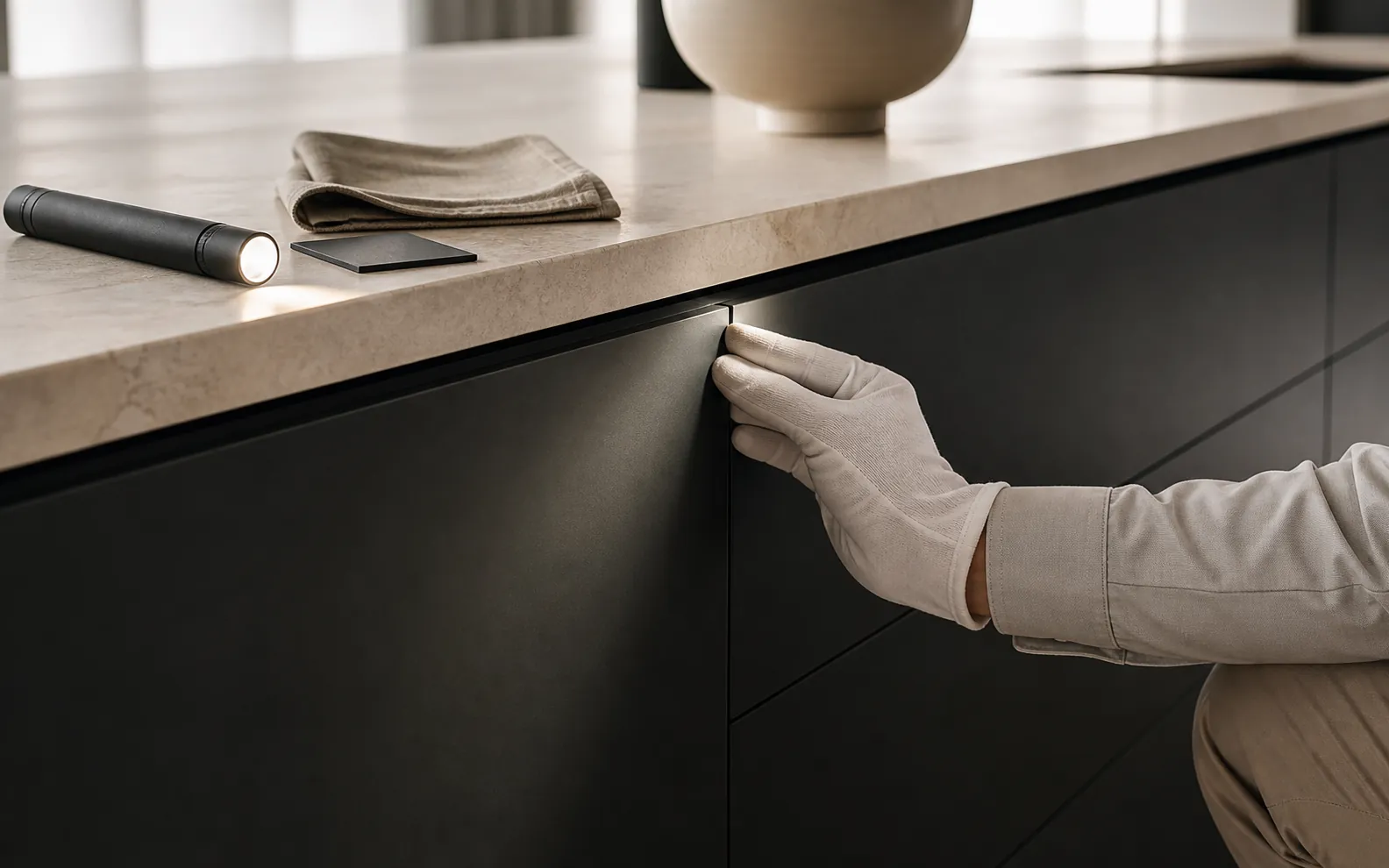
A proportionate response for a homeowner or project team is to:
- Complete dust-producing and high-emission site work before final furniture installation where possible
- Request material and finish documentation when the project or household has defined requirements
- Avoid sealing newly installed goods in an unventilated villa
- Operate and maintain HVAC as directed by qualified building professionals
- Investigate persistent odours or symptoms rather than masking them with fragrance
- Use an appropriately accredited testing provider when required or clinically prudent
This is risk management, not diagnosis. Odour alone does not identify a contaminant or prove a concentration is unsafe, and an "eco" label alone does not establish indoor-air performance.
How should you check everything on handover?
Inspect room by room, against the approved record, using the item codes. For each item, check:
- Correct model, configuration, quantity and finish
- Level, stability and alignment
- Doors, drawers, mechanisms and electrics
- Upholstery seams, pattern direction and surface condition
- Stone, glass, lacquer, metal and timber for transit damage
- Wall fixing and cable management
- The relationship to lights, curtains, sockets and circulation
- Keys, remotes, spare parts and accessories
- Care instructions and warranty documents
- Packaging removal and final protection
A snag should identify the item, location, defect, evidence, owner and target action. "Dining table damaged" is not actionable. "DT-01, west edge, 18 mm chip visible on arrival; item isolated, condition photos attached, supplier remedy proposal required" is. And do not rush into styling around unresolved defects.
The one-page release gate
Before you issue an order, every critical item should pass these questions:
- Is household use and room layout frozen enough for the decision?
- Has the relevant finished site been surveyed?
- Do the installed and packed dimensions work?
- Is the complete access route verified?
- Are the model, configuration, orientation, materials and finish unambiguous?
- Are samples approved and retained?
- Are neighbouring services and products coordinated?
- Does the supplier acknowledgement match the schedule?
- Are cost inclusions, delivery ownership and warranty clear?
- Is the required-on-site date supported by dependencies rather than optimism?
- Is a condition-report and snagging process in place?
A "no" does not always stop the whole villa. It stops that item from becoming an expensive assumption.
Should you furnish the whole villa at once, or in phases?
A coordinated package is valuable when many rooms, suppliers and installation dependencies must resolve together, but it is not automatically the best route. Phase the work when the household still needs to learn how the villa is used, when rooms may change purpose, or when a hurried deadline would otherwise force weak substitutions. Complete the rooms that support daily life first, and live with the circulation and light before committing to secondary pieces.
A hybrid approach often works best: give an exceptional made-to-order anchor piece full coordination, and keep the secondary furniture flexible. A mature procurement plan does not maximise custom orders. It places precision where mistakes would be costly and flexibility where the future is uncertain.
The best furniture installations look effortless because the effort happened earlier: use was defined, measurements were verified, samples were retained, interfaces were resolved and delivery was designed before the truck arrived.

Frequently asked questions
When should I start selecting furniture for a Dubai villa?
Start space planning and defining use before handover if reliable drawings are available; verify critical dimensions at the finished site before releasing size-sensitive orders; and begin with the longest or most complex dependencies rather than the accessories.
Should I furnish the whole villa at once?
Not necessarily. Furnish at once when the brief is stable and coordinated installation creates real value. Phase the work when room use is uncertain, the site is not ready, or a deadline forces compromises. Prioritise bedrooms, daily living, dining and essential window and privacy requirements.
What dimensions does a furniture supplier need?
Finished room dimensions, service positions, circulation requirements and the complete access route. For larger pieces, compare the supplier's packed dimensions and handling instructions with your gates, doors, stairs, lifts, landings and turning points.
What should be checked before paying a deposit?
The exact model and configuration, dimensions, quantity, materials, finish codes, approved samples, commercial inclusions, payment stages, stated programme, cancellation terms, delivery responsibility, warranty and the supplier's order acknowledgement. Obtain project-specific advice where legal or contractual interpretation is required.
How do I reduce risk with imported or made-to-order furniture?
Freeze the specification, keep labelled samples, confirm packed dimensions and access, use documented approvals, clarify freight and insurance ownership, agree condition evidence, and avoid scheduling installation before the villa is ready. For high-risk pieces, agree an appropriate pre-dispatch inspection.
Sources
- Dubai Municipality, Technical Guidelines for Indoor Air Quality for Healthy Life, Version 4
- Forest Stewardship Council, Chain of Custody Certification
- FCI UAE, Luxury Furniture Procurement in the UAE
- FCI UAE, Luxury Interior Procurement
- FCI UAE, Contact and consultation
- InStyle Direct, Furnishing New Builds in Dubai
- BSA Trading, Dubai Villa Furniture Package Guide
- TUKA Dubai, Villa Furniture Package Guide