

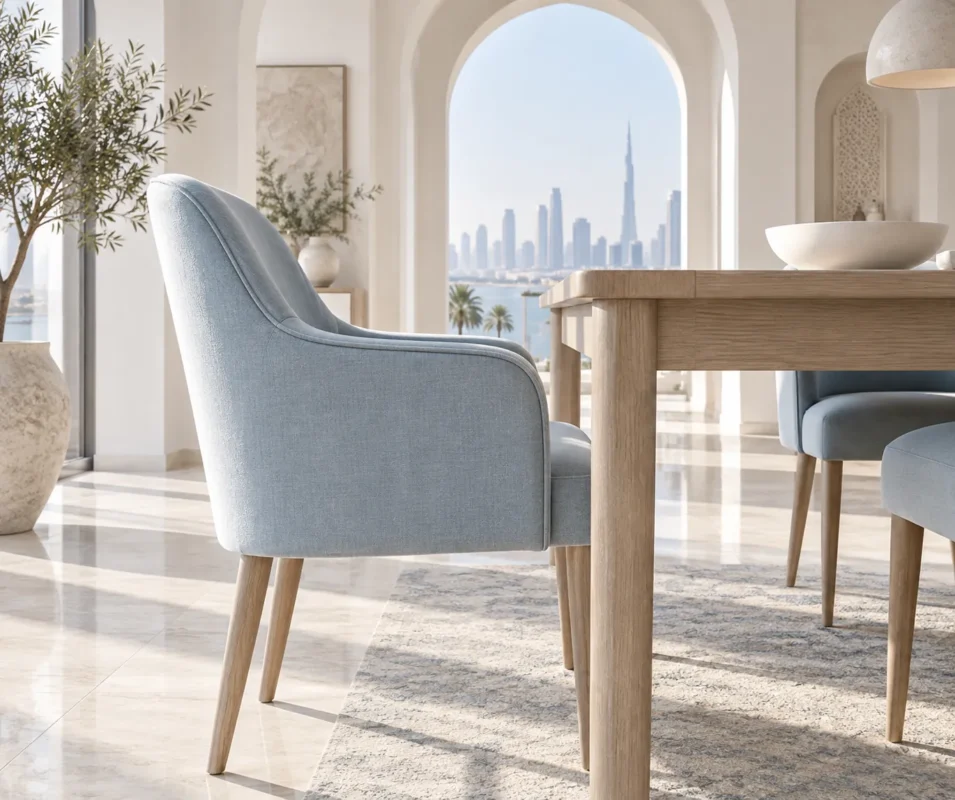
TL;DR: Dining chairs with arms need clearance beneath the table, space between its supports and enough room to get in and out, not just a matching finish.
Key takeaways
- Compare armrest height with the lowest obstruction beneath the table, not simply the height of the tabletop.
- Check the chair's widest point against the clear space between table legs or supports.
- Test the chair in three positions: tucked away, occupied and pulled out for someone to stand.
- A swivel mechanism changes the movement to test; it does not remove the need for clearance.
- Approve the exact chair-and-table combination before ordering the full set.
Will dining chairs with arms fit under your table?
They will tuck in only as far as their arms, back and base can travel without meeting the table's underside or supports. Checking armrest height against the table edge is also part of Chattels & More's published armchair buying guidance.
Start by deciding what you mean by fit. Do you want the seat completely beneath the table, or are you happy with an intentional gap? A chair can work well for dining without disappearing under the tabletop. The problem is discovering that distinction after delivery.
For a Dubai apartment where the dining area shares a route to the balcony or kitchen, our recommendation is to agree the parked position first. Photograph the route with the existing chairs in place, then mark where the proposed chair backs would sit. A handsome chair should not turn the everyday route into a sideways shuffle.
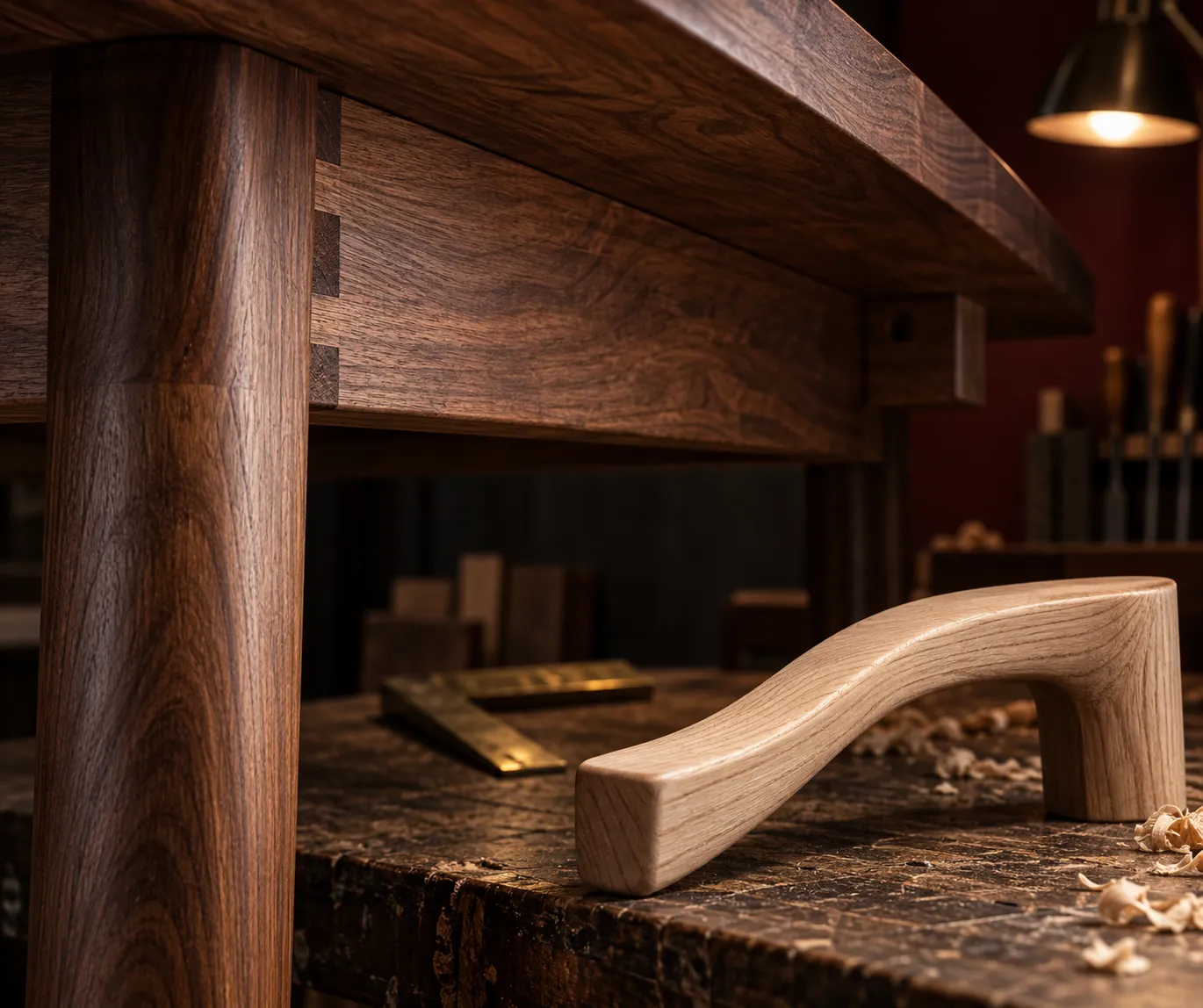
Browse FCI UAE's dining chairs with that footprint in mind. Ask for the current dimensions of the precise model and base you are considering, rather than relying on the collection photograph.
Which heights should you measure separately?
Measure the seat, the arms and the table's underside separately because each answers a different fit question. Wayfair's dining-height guide distinguishes table height from seat height; arm clearance needs its own check.
The table apron is the frame or rail immediately beneath the tabletop. On your chosen table, also look for extension hardware, brackets or a lower edge that could meet the chair. Record the lowest relevant obstruction along the actual path the arms would take.
For the chair, request floor-to-arm height and ask where that measurement is taken. A sloping arm may have a higher point further back. Do not substitute the chair's overall height, which usually describes the top of the back, for the height of its arms.
Our suggested measurement record is simple:
| Measurement | What it helps you decide |
|---|---|
| Floor to seat surface | Whether the dining position suits the user and table |
| Floor to highest relevant arm point | Whether the arm can pass beneath the table |
| Floor to lowest obstruction | What the chair actually has to clear |
| Tabletop height | Where the dining surface sits, not whether the arm fits |
Do not design the combination around two surfaces just touching. Ask the supplier to allow for the final upholstery, glides, floor finish and any rug, and to confirm the resulting clearance. This is a pair-specific specification, not a universal centimetre rule.
Why does chair width matter as much as height?
Chair width matters because the arms or base can meet the table legs even when there is enough vertical clearance. Treat the clear opening between supports as a separate measurement from the length of the tabletop.
Record the chair's maximum width, not only its seat width. Then look beneath the table from the intended sitting position. Check angled legs, pedestal shoulders and stretchers, the connecting bars between supports, rather than assuming the space beneath a large top is empty.
At the end of a rectangular table, test the end chair alongside the adjacent side chairs. Our recommendation is to try the whole corner arrangement before approving matching armchairs everywhere. A seat count on a table description is not confirmation that your chosen chairs work in that arrangement.
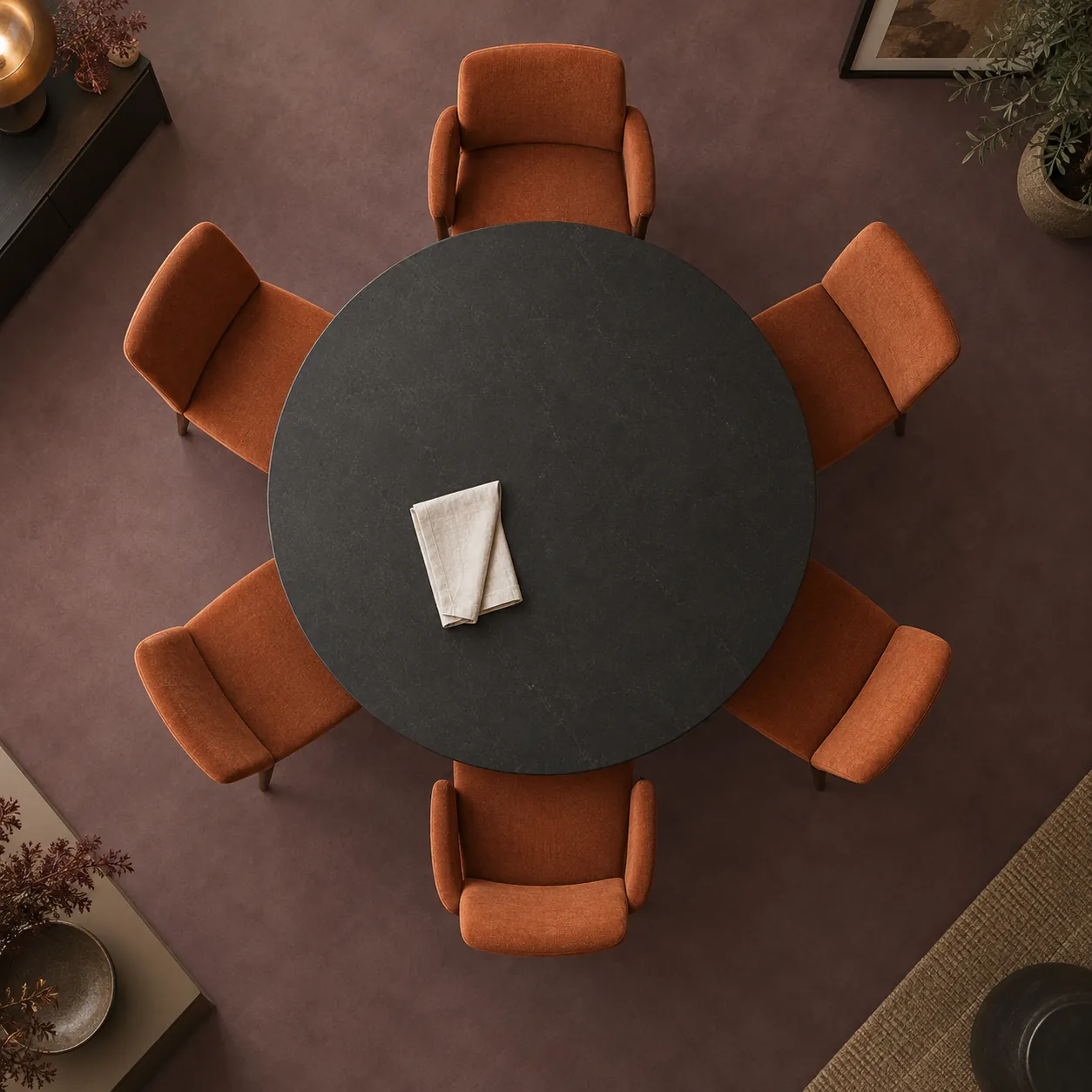
For a round table, repeat the exercise at each proposed position. Think about where knees and feet go as well as where the upholstered shell sits. The tabletop is only the visible part of the negotiation.
Do swivel dining chairs solve a tight layout?
A swivel chair changes how you enter and leave the seat, but it still needs a clear movement path. Test the actual rotation with the table, neighbouring seats and nearby wall in place.
We suggest checking the arm at several points through its movement, not only with the chair facing forwards. Ask whether the chosen version returns to a starting position and whether the base projects beyond the seat. Do not assume that two versions of the same chair share the same footprint.
Then sit down, reach towards the table and stand up again. Keep this a normal-use trial, not an attempt to force the chair through an awkward gap. If different household members will use the seat, include them in the decision rather than treating one person's fit as everyone's approval.
Should every dining chair have arms?
No, the layout can mix chairs with and without arms if that better suits the table and its users. Chattels & More's guide describes using armchairs at the head and foot with armless chairs along the sides.
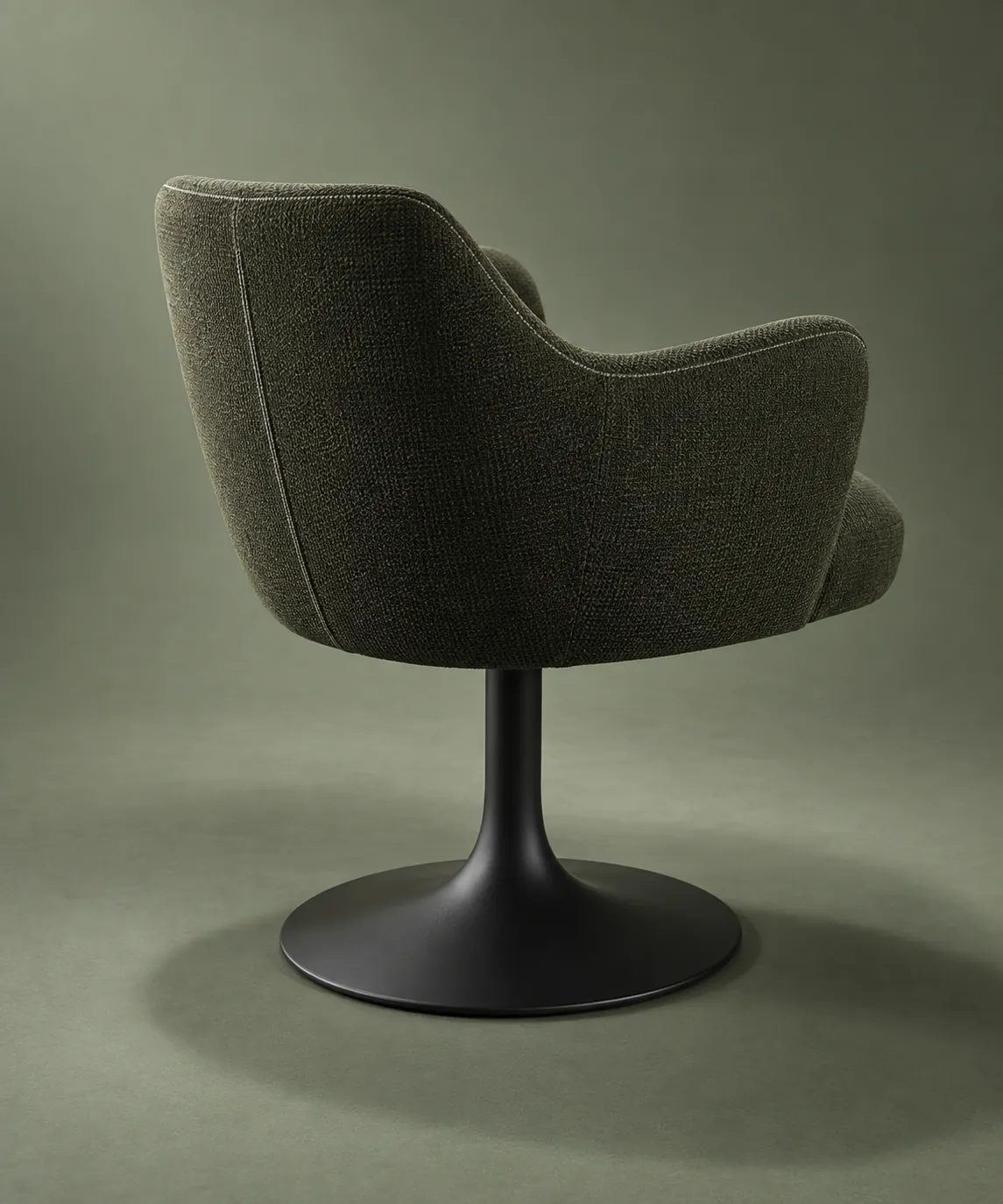
For a Dubai home used for both everyday meals and larger gatherings, our preference is to plan the everyday arrangement first. Check any additional chairs as a separate hosting arrangement. Do not buy the maximum theoretical count and expect the daily route to look after itself.
Keep finish choices separate from dimensional approval. The current Eva Con Braccioli listing at FCI UAE describes customisable materials and finishes, but that is not a statement that the chair fits a particular table. Request the drawing and the relevant dimensions for your proposed version.
What should be agreed before ordering?
Agree a written pair-specific fit record covering the exact chair, table and room arrangement. Our recommended record includes the model codes, base, upholstery, arm height, maximum width, under-table obstructions and intended parked position.
Add photographs of a trial where possible. If the precise combination cannot be tried, ask what the supplier can verify from drawings and what remains untested. Record that distinction rather than converting a promising sketch into a guarantee.
Finally, agree who checks the delivered pieces against the approved specification. Include the dining rug and floor protection in the room plan, and ask for care instructions for the actual finishes supplied.
Limitations
This is a buying and measurement framework, not an ergonomic assessment, accessibility specification or guarantee of fit. Retail sizing guidance cannot replace the dimensions and normal-use trial of your chosen furniture. We have not tested the products shown on FCI's site.
Generated images are conceptual illustrations, not FCI catalogue photography, completed projects or measured layouts.

What is the next step for your Dubai dining room?
Send the table measurements and room plan before choosing the full chair set. Contact FCI UAE with underside photographs, the desired chair count and the route that must remain usable, then ask for a shortlist against those constraints.
That is a more useful brief than asking for six beautiful chairs and hoping the table is feeling accommodating.
Sources
- Armrest Dining Chairs, Chattels & More. Live UAE retail buying guide, used for arm-height checks and mixed seating, not universal sizing rules.
- How to Find the Perfect Dining Table Height, Wayfair. Retail measurement guidance, used to distinguish seat and table heights.
- Dining Chairs, FCI UAE. Current commercial category.
- Eva Con Braccioli Dining Chair by Logo, FCI UAE. Current first-party product listing; no dimensional fit claim is inferred.
- Contact FCI UAE. Current enquiry route.